Why “Good Enough” Is the Enemy of Progress
📖 Abstract: The Death of the Outlier
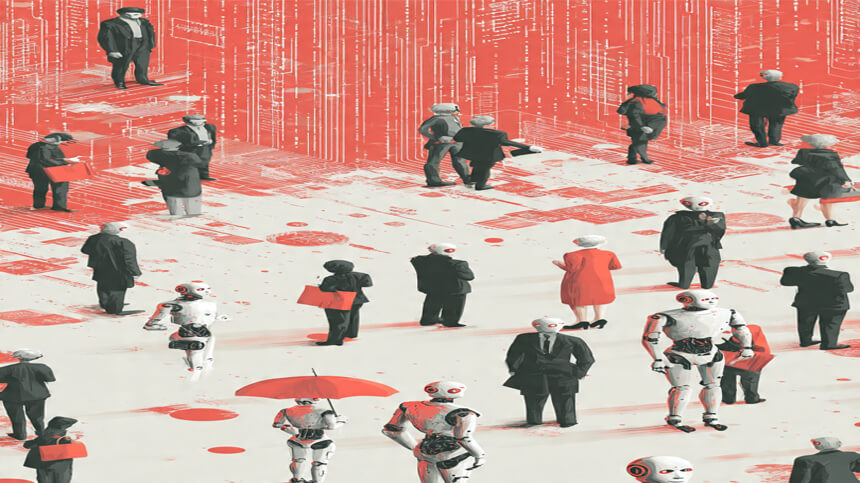
Artificial Intelligence is, at its core, a prediction engine built on the Average. It scans the vast dataset of human history and calculates the most statistically probable next step. In the Age of AI, “innovation” has been quietly replaced by “optimization of the median.”
In the Philippines, this is devastating. Our legacy systems are already plagued by Organized Stupidity and Patronage. Feeding this into AI doesn’t create a new future—it simply perfects the mediocre past. We are entering a state of The Tyranny of the Median, where every policy, every corporate strategy, and every political speech is a polished, AI-generated version of “good enough.”
The uncomfortable truth: the Average is the ultimate enemy of national progress. The only way to break the Sisyphean Cycle is to reclaim the high-friction, non-statistical outlier—the original human vision.
⚡ 1. The Regression to the Mean
When AI drafts a “Smart City” proposal for a Philippine province, it doesn’t see the messy, beautiful reality of that land. It sees the average of 10,000 successful cities abroad and generates a simulated solution.
- The Problem: The “Average” doesn’t account for our steeper mountains, deeper floods, or “Frayed Wires” (see The Parable of the Optimized Grid).
- The Result: We build “Plazas of the Future” that look great on a render but collapse within six months—optimized for a median climate and culture, not ours.
The regression to the mean erases the very genius we need to survive.
🧩 2. The Political Echo: The Average Leader
The Epal Protocol has been upgraded. Before, politicians had to pretend to have unique platforms. Now, they use AI to mirror the most “relatable” sentiment on social media.
- The Sentiment Loop: If 60% of people are angry, the AI ensures the politician’s statement is exactly 60% angry.
- The Loss of the Visionary: We are trading the Uncomfortable Truth for the Comfortable Average. Leaders become visible pawns of the dataset—reflecting the mountain back at us instead of leading us out of it.
Leadership has been reduced to Statistical Compliance.
🎭 3. The Filipino Creative: Drowning in the Median Blob
As explored in The Trinity of the Automated Soul, our creative class is pressured to produce at machine speed. To keep up, they rely on AI models trained on the Median of Taste.
The result? The Homogenization of the Archipelago.
- Our art, music, and narratives lose their “Outlier” status—the weird, wonderful traits that make Filipino creativity world-class.
- We produce a Median Blob of content: perfectly aesthetic, profoundly forgettable.
The machine rewards conformity. The outlier is erased.
♟️ 4. Breaking the Tyranny: The Cult of the Outlier
How do we survive the Tyranny of the Median? By deliberately seeking the Non-Statistical.
- Reward the Error: In a world of AI-perfected mediocrity, the “Happy Accident” is proof of human life. Prioritize the “Flaw of the Hand”—the imperfections AI would erase.
- The Contextual Audit: Use AI not to generate solutions, but to identify where the average fails. Instead of asking “What’s the best way to build a road?” ask “Where does the global average fail to account for Philippine monsoon patterns?”
- Reject the Script: When a politician or CEO speaks, ask: “Could a machine have calculated this sentiment?” If yes, they serve the Median, not the people. True power belongs to the Unpredictable (see The Power of Invisibility).
📢 Conclusion: The Final Transaction
The Median is comfortable. It feels safe because it is what everyone else is doing. But for a nation climbing a mountain while pushing a boulder, “Average” is just another word for Staying at the Bottom.
The Age of AI is an invitation to stop being a data point and start being a disruption. The only way to fill the Great Void is to stop feeding the machine what it expects—and start giving it the one thing it cannot calculate: the original, high-friction, un-optimized human soul.
Welcome to AIWhyLive.com, where we calculate the cost of your conformity and the fragile value of originality.

Why We Must Shatter the Myth of Eternal Struggle 📖 Abstract: The Infinite Cycle of Near-Success The ancient Greek myth Read more

We already know this much: college does not guarantee success. And as we’ve explored before, being smart does not automatically Read more

When “Open Data” Becomes a Closed Lie 📖 Abstract: The Glass Wall We Can’t See Through AI promises transparency—dashboards, audits, Read more

The Illusion of Lineage 📖 Abstract: The Illusion of Lineage The recurring push for an Anti-Dynasty Bill in the Philippine Read more