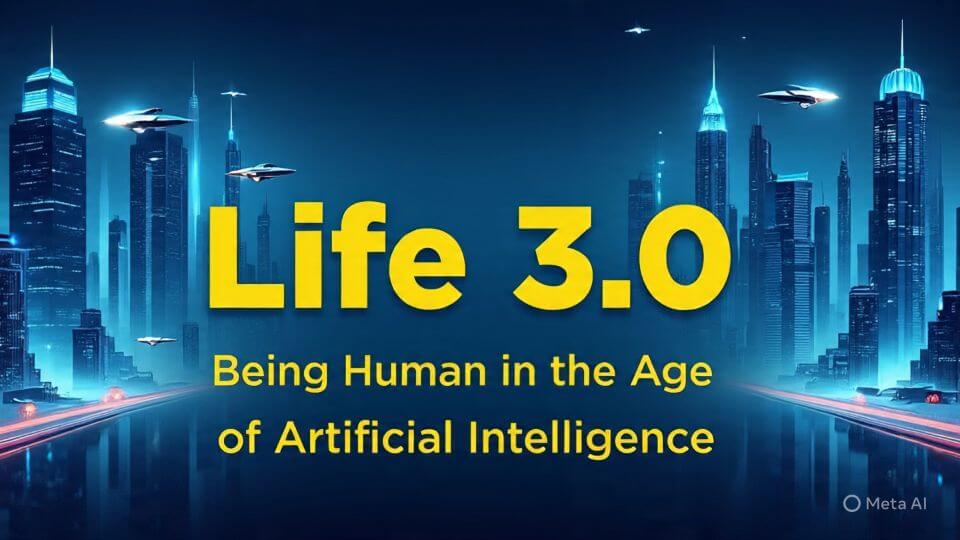
“From MIT to the Philippines: Life 3.0 and the Filipino Right to Design”
🧠 Introduction:
Max Tegmark’s Life 3.0: Being Human in the Age of Artificial Intelligence is a global bestseller that dares to ask the biggest question of our time: What kind of future do we want, and who gets to decide? Written by an MIT physicist, the book blends hard science with speculative storytelling, offering a buffet of possible AI futures—from utopias to dystopias, from benevolent machine rulers to decentralized techno-anarchies.
But for Filipino readers, especially those outside elite tech circles, the question isn’t just what future is possible—it’s who’s even invited to imagine it?
🔍 Key Ideas from the Book:
- Life 1.0 to 3.0: Tegmark defines three stages of life—biological (1.0), cultural (2.0), and technological (3.0). AI represents the leap to 3.0, where intelligence can redesign not just its software, but its hardware.
- The Control Problem: Who controls superintelligent systems? Governments? Corporations? Philosophers? Tegmark warns of power concentrating in the hands of a few.
- Ethical Futures: The book outlines multiple scenarios—some hopeful, some terrifying. It doesn’t predict, it provokes.
- Design Matters: Tegmark insists that values must be embedded in AI systems from the start. The design phase is political, not neutral.
🇵🇭 Filipino Relevance:
- Digital Dignity: In a country where AI is already used to sort job applicants, automate aid distribution, and monitor social media, Life 3.0 offers a framework to ask: Whose values are being coded?
- Agency vs. Automation: Tegmark’s scenarios often assume a global elite making decisions. But in the Philippines, micro-entrepreneurs, youth coders, and barangay health workers are already hacking AI for survival. Their stories deserve space in the design room.
- Policy Wake-Up Call: The book’s warnings about unchecked AI power resonate with Filipino realities—where tech often outpaces regulation, and digital tools are deployed without public consent or understanding.
⚖️ Honest Verdict: Should Filipinos Read Life 3.0?
Yes—but with a critical lens. Tegmark’s book is brilliant in scope and accessible in style. It’s a rare mix of science, philosophy, and storytelling that can spark deep reflection. But it’s also written from the mountaintop—by and for those already shaping the future.
Filipino readers should treat Life 3.0 not as gospel, but as a provocation. It’s a call to reclaim the narrative, to ask: What does Life 3.0 look like in a sari-sari store, a cosplay convention, or a mental health chatroom in Bacolod? And more importantly: Can the poor program the future, too?
🧠 Too Cryptic? Explain Like I’m 12 (ELI12)
What’s Life 3.0 about? It’s a book that asks: “What happens when AI gets smarter than humans?” The author, Max Tegmark, says we’re entering a new phase of life—where intelligence isn’t stuck in brains or bodies. It can upgrade itself, spread across the universe, and maybe even control everything.
What are Life 1.0, 2.0, and 3.0?
- 🐙 Life 1.0 = animals. They evolve slowly and can’t change how they think.
- 🧍 Life 2.0 = humans. We can learn, but we’re still stuck with our biology.
- 🤖 Life 3.0 = future AI. It can redesign itself, learn anything, and maybe live forever.
Why does it matter? Because whoever controls AI could control the world. Tegmark says we need to plan now—before it’s too late.
What’s missing? The book talks a lot about space, superintelligence, and rich tech companies. But it barely mentions poor countries, real-life struggles, or how ordinary people can shape AI. So we ask:
Can Filipinos be part of designing the future—or are we just background characters in someone else’s sci-fi?
Money isn’t just numbers.It’s not just about how much you earn or how smart you are.It’s about how you think Read more
What happens when a 19th-century revolution meets 21st-century algorithms? What if Jose Rizal wrote Noli Me Tangere today, not with Read more
Introduction: Are We Still Surrounded by Idiots? More than a decade after its release, Thomas Erikson’s book, Surrounded by Idiots, Read more
🔍 What Is Mastery? Published in 1992, Mastery: The Keys to Success and Long-Term Fulfillment by George Leonard is a Read more